~/Documents/Projects/sumner-norman/bci-scaling.md
BCI Scaling
How fast implanted brain-computer interfaces move information.
- 012000Kennedy & Bakay: neurotrophic electrode3 char/min0.24source
- 022015Bacher et al.: radial keyboard10 char/min0.79source
- 032015Jarosiewicz et al.: self-calibrating typing0.93 bits/s0.93source
- 042016Vansteensel et al.: ECoG click speller, home use2 char/min0.16source
- 052017Pandarinath et al.: ReFIT-KF, grid task3.7 bits/s3.70source
- 062018Milekovic et al.: LFP speller6.88 char/min0.55source
- 072021Synchron Stentrode: endovascular switch0.5 bits/s0.50source
- 082021Moses & Chang: ECoG speech, 50-word15.2 words/min1.31source
- 092021Willett et al.: handwriting, 90 cpm90 char/min7.13source
- 102023Willett et al.: speech, 62 WPM62 words/min5.34source
- 112023Metzger & Chang: ECoG speech, 78 WPM78 words/min6.72source
- 122024Card & Stavisky: speech, 32 WPM, 2.5% WER32 words/min2.76source
- 132024Neuralink PRIME: Webgrid, 9.5 BPS9.5 bits/s9.50source
- 142025Card & Stavisky: speech, 56 WPM, home use56 words/min4.83source
- 152026Jude et al.: finger typing, 110 cpm110 char/min8.72source
- 162026Neuralink: Webgrid, 11.32 BPS11.32 bits/s11.3source
- 172026Neuralink VOICE: speech, 75 WPM75 words/min6.46source
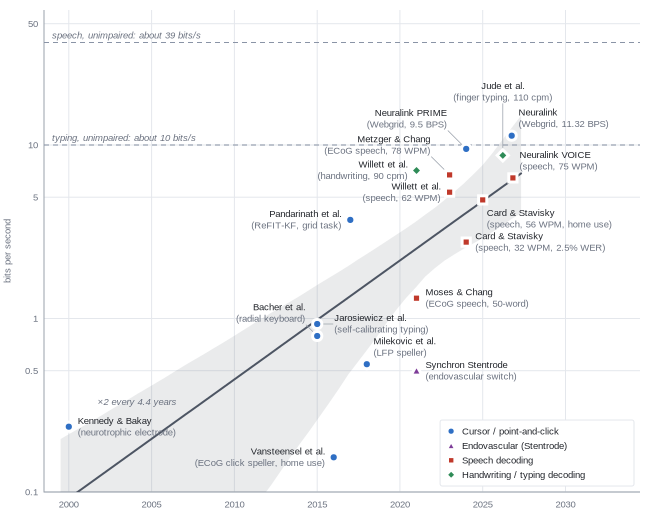
What this shows
Implanted brain-computer interfaces are getting fast. They're approaching speeds that match unimpaired people typing.
Each point is a published result from a person using an implanted BCI, converted to bits per second. The line is a log-linear fit through all of them and the band is its 95% interval. Point at one for the number behind it. Click or tap it to jump to its row and its paper.
The dashed lines are people without a BCI: about 10 bits/s typing and about 39 bits/s speaking.
The motor barrier
Every result here decodes an attempted movement: a cursor, a pen, a keystroke, speech. That puts the ceiling where movement puts it. More electrodes won't be enough to break through the motor barrier.
How the numbers are made
- Cursor and grid tasks: the achieved bitrate, as the authors reported it.
- Typing and handwriting: correct characters per minute × 4.75 bits per character, which is log2 of 26 letters and a space.
- Speech: words per minute × 5.17 bits per word.
These are not one yardstick. Characters are scored against the raw alphabet and words against English after its redundancy, so handwriting at 90 characters a minute sits above speech at 62 words a minute. Tan Gemicioglu's ITR Atlas puts every result on one stricter basis and covers far more interfaces, including the ones that don't touch the brain.
Neuralink's numbers are company-reported and have not been peer reviewed.